Blog Details
An Analysis of the Nine Major Application Areas of Suspension Assemblies
Release time:
2026-03-06 13:51
Source:
An Analysis of the Nine Major Application Areas of Suspension Assemblies
As a core component of the vehicle chassis, the suspension assembly achieves an elastic connection between the vehicle body and wheels through the coordinated operation of elastic elements, shock absorbers, and guiding mechanisms. Its functions extend beyond merely cushioning road impacts; it also plays a crucial role in aspects such as handling stability, ride comfort, and overall vehicle performance. This article will analyze the technological evolution and application value of suspension assemblies across nine major sectors: passenger vehicles, commercial vehicles, new-energy vehicles, special-purpose vehicles, intelligent driving, motorsports, military equipment, rail transit, and construction machinery.
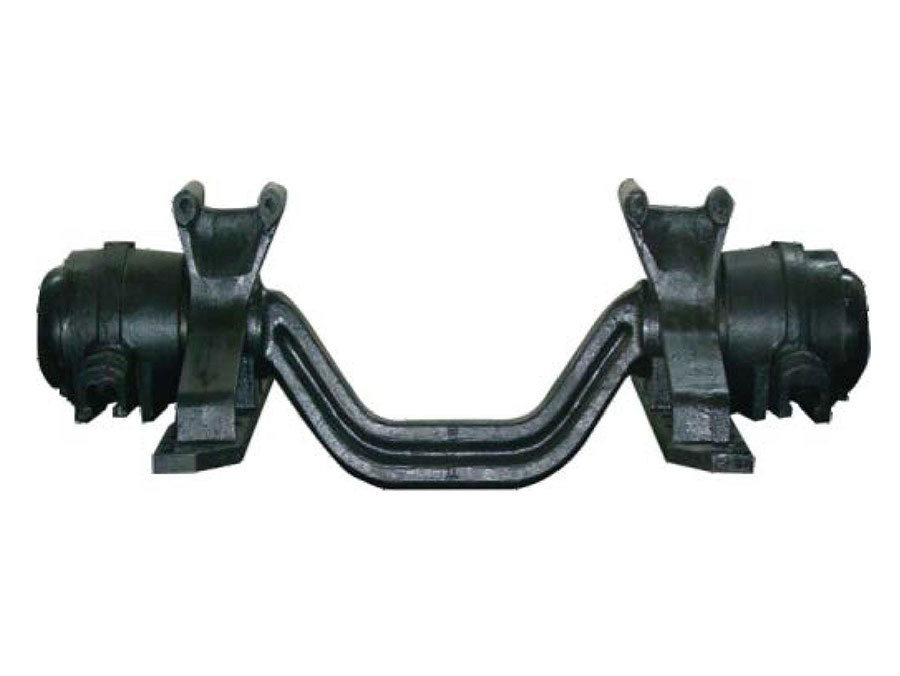
I. Passenger Vehicles: The Art of Balancing Comfort and Handling—The Balance Between Performance and Handling
In the passenger car segment, the design of suspension assemblies must strike a balance between comfort for daily commuting and handling performance during high-speed cornering. The MacPherson independent suspension, with its compact structure and low cost, has become the mainstream choice for front suspensions in family sedans. However, it has relatively weak roll resistance, so it is often reinforced by adding a lateral stabilizer bar. The double-wishbone suspension, with its upper and lower A-arm layout, effectively suppresses brake dive and steering roll, and is commonly found in performance models from luxury brands. Meanwhile, the multi-link suspension—through dynamic optimization of wheel alignment parameters via 4 to 5 linkages—has become the preferred rear suspension solution for high-end vehicles. For example, the Porsche 911, featuring a front double-wishbone and rear multi-link combination, demonstrated the suspension’s ability to enhance handling limits by achieving a lap time of 2 minutes and 7 seconds on the Nürburgring circuit.
II. Commercial Vehicles: A Dual Test of Load-Carrying Capacity and Durability
Commercial vehicle suspensions must withstand harsh operating conditions, including heavy loads and high-frequency vibrations. Non-independent leaf-spring suspensions, with their simple structure and low cost, account for over 80% of the medium- and heavy-duty truck market. These suspensions achieve elastic support by stacking multiple leaf springs, with each leaf capable of bearing up to 3 tons. Air suspensions, on the other hand, are rapidly gaining traction in the high-end bus and hazardous chemical transport vehicle segments. By using an ECU to control the inflation and deflation of air bags, air suspensions maintain a constant vehicle height and enable adaptive load adjustment. Data shows that in 2024, domestic sales of commercial vehicles equipped with standard air suspensions increased by 44.7% year-on-year. Among them, companies such as WABCO and Konghui Technology have expanded the adjustable range of suspension stiffness threefold through their dual-chamber air spring technology, significantly enhancing driving stability under heavy-load conditions.
III. New Energy Vehicles: New Demands for Lightweight Design and Energy Efficiency Optimization
New-energy vehicles pose a dual challenge to suspension systems: the increased unsprung mass caused by battery packs must be offset through lightweight design, while range anxiety demands reduced suspension energy consumption. Aluminum alloy materials have already become widely adopted in double-wishbone suspensions, accounting for over 60% of such systems and offering a 40% weight reduction compared to steel structures. Electromagnetic suspensions, which use magnetorheological fluids to achieve damping adjustments within milliseconds, enabled the Tesla Model S Plaid to accelerate from zero to 60 mph in just 1.98 seconds, while keeping pitch angles within ±2°. Additionally, BYD’s Cloud Suspension-C system employs a “skyhook” control algorithm that reduces body vibration frequency to 1.2 Hz, bringing it close to the level typically found in luxury sedans.
IV. Special Vehicles: Adaptive Evolution Under Extreme Operating Conditions
In the field of mining dump trucks, the oil-gas spring non-independent suspension—by combining high-pressure nitrogen gas with hydraulic oil—achieves a single-cylinder load-bearing capacity exceeding 50 tons while also featuring a stroke amplification function, enabling the vehicle to maintain tire-ground contact even on slopes as steep as 30%. As for fire truck suspensions, they employ a variable-stiffness design: when stationary during firefighting, the vehicle’s body height is lowered to enhance stability; while driving, the chassis automatically rises to improve off-road performance. For example, the Mercedes-Benz Arocs fire truck utilizes hydraulic interconnected suspension technology to reduce the roll angle from 8° to just 3°, significantly improving the precision of high-pressure water jet operations.
V. Intelligent Driving: A Closed-Loop Control System of Perception-Decision-Execution
Level 4 autonomous driving places higher demands on suspension systems: they must work in coordination with sensors such as lidar and cameras to enable predictive road-surface sensing. The wire-controlled active suspension equipped on NIO’s ET9 uses a forward-facing camera to detect road surface undulations within a 50-meter range ahead, adjusting suspension stiffness and damping in advance to reduce body vibration amplitude by up to 60%. Huawei’s Tuling chassis, on the other hand, integrates 4D millimeter-wave radar capable of detecting road surface changes at the 0.1mm level. Paired with CDC electromagnetic dampers, this system keeps vertical acceleration on bumpy roads below 0.3g—approaching the ride experience of maglev trains.
6. Motorsports: Breaking Performance Barriers Under Extreme Conditions
The F1 race car features a pushrod-type double-wishbone suspension, which uses carbon-fiber materials to reduce unsprung mass to below 8 kg. Paired with an active hydraulic suspension system, the front suspension stiffness increases by 300% during braking, significantly reducing the "nose-dive" phenomenon. The Le Mans 24-hour endurance race prototype, on the other hand, employs a multi-link plus torsion-bar composite suspension. By dynamically adjusting the preload of the torsion bars in real time, the vehicle maintains a lateral acceleration of 1.5 g even in high-speed corners. The Porsche 919 Hybrid race car, through coordinated control of its front and rear suspensions, set a lap record of 2 minutes and 43 seconds at the Spa circuit—suspension systems alone contributed 12% to the improvement in cornering speed.
7. Military Equipment: Technical Support for All-Terrain Mobility
The suspension systems of military off-road vehicles must meet the demands of challenging terrains such as sand, swamps, and rocky surfaces. The Humvee H1 features a front-and-rear double-wishbone suspension combined with coil springs, complemented by a central tire inflation/deflation system that can reduce tire pressure from 2.4 bar to 0.8 bar in just 30 seconds, thereby enhancing traction on soft ground. In China, Dongfeng Mengshi has innovatively adopted a hydraulically interconnected suspension system. Through interconnected pipelines linking four hydraulic cylinders, this system disperses the impact energy from individual wheels throughout the entire vehicle, enabling the vehicle to maintain body stability even on slopes as steep as 40%. This significantly improves the stability of the fire-control system.
8. Rail Transit: Vibration Isolation Under High-Speed Operation
The high-speed railway bogie suspension system employs a combination of air springs and hydraulic dampers. Through active control technology, the vehicle body’s vibration acceleration is kept below 0.1 m/s², representing a 70% reduction compared to conventional steel-spring suspensions. On Japan’s Shinkansen E7 series trains, a ceiling-mounted damping control algorithm ensures that, when operating at 320 km/h, the liquid level in coffee cups inside the carriages experiences minimal fluctuation.
Related Information
An Analysis of the Nine Major Application Areas of Suspension Assemblies
As a core component of the vehicle chassis, the suspension assembly achieves an elastic connection between the vehicle body and the wheels through the coordinated operation of elastic elements, shock absorbers, and guiding mechanisms.
The development strategy of Xuchang Jinggong Machinery Manufacturing Co., Ltd!
Our company is committed to becoming the domestic balance suspension assembly research and development production base.
How to maintain the balance suspension assembly?
The maintenance of the balance suspension assembly is an important link to ensure the stability and safety of the car!

Professional R & D and production of heavy truck balance suspension assembly